

Onduline’s commitment to sustainability
Our roofing experts offer innovative products and solutions to protect people against the elements while contributing to environmental preservation.
About our production
We pay close attention to our manufacturing process, designed to be low in energy consumption and generate no dangerous waste. We are working to reduce or limit the use of all fossil fuels, for example:
by using "green" electricity from renewable sources,
by installing photovoltaic panels on our factories (such as in Mielec, Poland, or Penang, Malaysia),
by replacing fuel-powered forklifts with electric models,
by working on solutions to replace natural gas with biomethane,...
We recycle about 46,400 tons of material* using high-tech recycling processes. All these initiatives enabled us to reach 5,49 kg CO2 / m² positive carbon footprint for the roofing sheets and 4,46 kg CO2 / m² for the underroofing sheets**.
*in 2024, consisting mainly of cellulosic fibres for our Bituminous Roofing Sheets. Asphaltic oil, IPP & reinforcement (PET) for our Bituminous Membranes.
** Calculated in 2024 by IBU.
About our solutions
We have always provided asbestos-free and lightweight solutions, easy to carry and install, meaning less energy is used for the transport of these Roofing and Under-roofing materials, the structure is lighter as it only supports up to 3,5 kg/m² in average… Not to mention acoustic* and thermal comfort** for end-users.
* contributes to a 3,3 times quieter atmosphere inside homes compared to metal roofs
** With a λ= 0,12 W/mK, an effusive material providing better comfort during warm periods, and retaining warmth inside during cold ones
Our proofs are assessed by reliable third-parties

- Onduline’s carbon footprint / Environmental Product Declaration (EDP)
5.49 kg of CO2 emissions per m² for our bitumen sheets and 4.46 kg of CO2 emissions per m² for our bitumen under-roofing sheets.
IBU, March 2024
- We are the first company to apply for an EPD for our bitumen corrugated product family. We thus created a Product Category Rule for Roofing and Wall Cladding (PCR) that was accepted in July 2012 by German Institute IBU. This PCR will be the basis for all future EPDs for all suppliers.
EPD provide quantified and required data to monitor life circle assessment (LCA) impact.
- Recycled content (VAR 1016)
ICC-ES, June 2024
Recycled content and EPD provide elements for LEED certifications or green standards for sustainable green building operations.
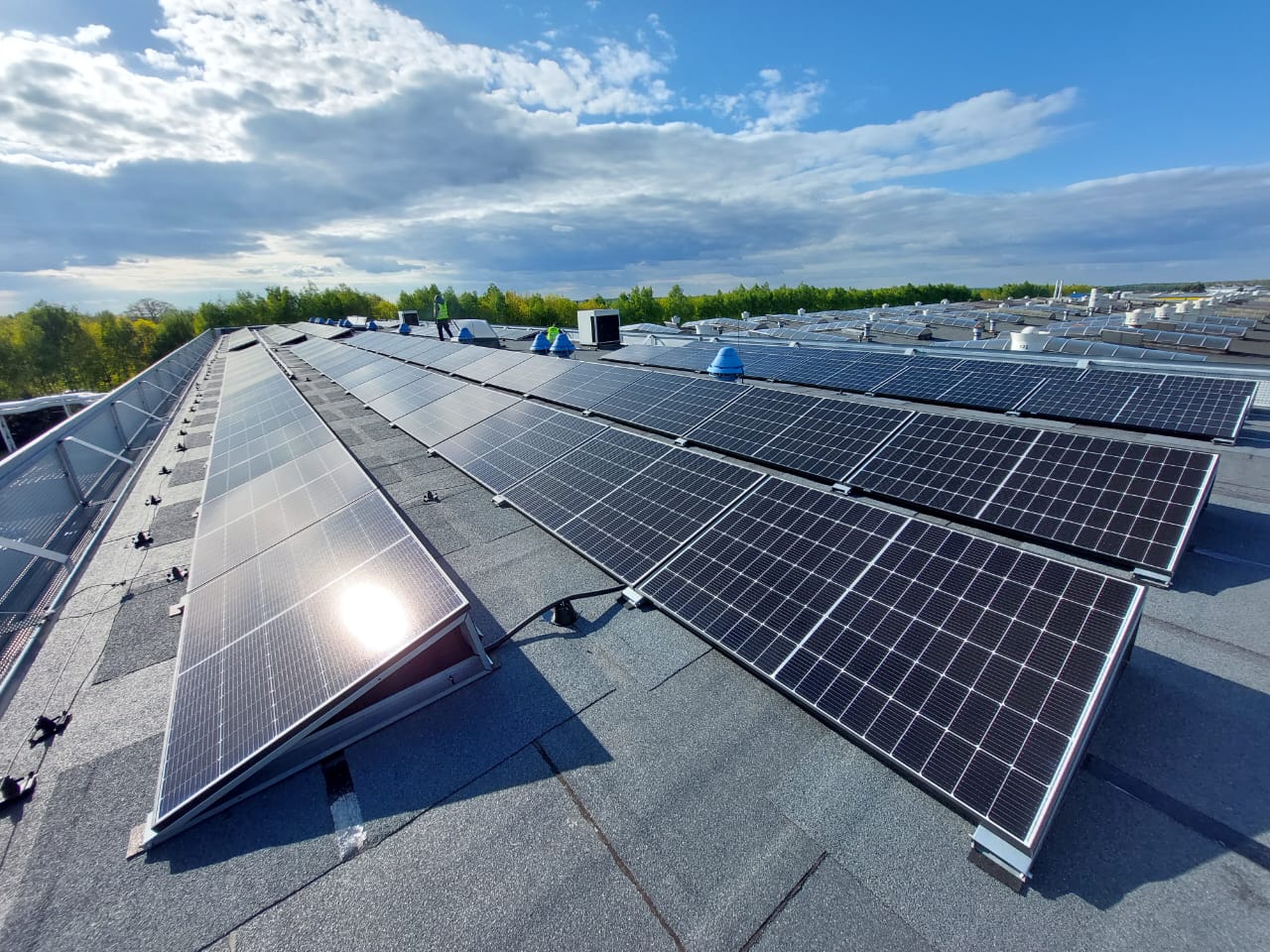
Photovoltaic panels installed on our Mielec plant (Poland)